
Starting solids
“How do I start solids?”
One calm step at a time.
- Readiness check
- One allergen at a time
- Textures by age
Free food library
“How do I serve this?”
41 foods, by age. No app needed.
- 6 to 8 months
- 9 to 11 months
- 12 months+
Free to read. No account.
In the app
“What do I feed my baby today?”
Today’s food and how to serve it.
- Today’s food
- How to serve it
- What to watch for
Free for your first 14 foods.
Get today’s plan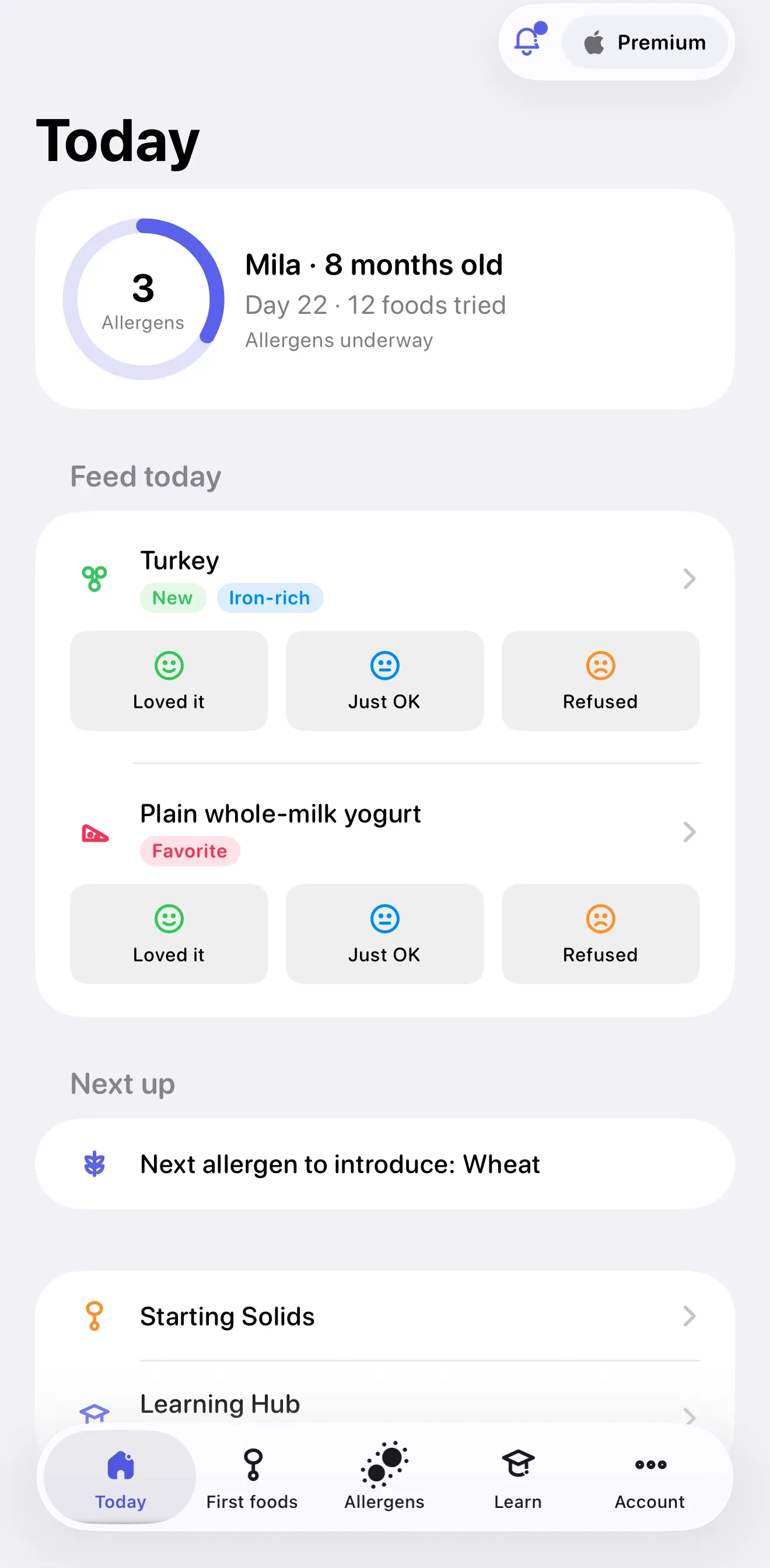
On every plan
What’s free?
These never need a subscription.
- Foods to avoid, choking, reaction signs
- Allergen log: every exposure, every reaction
- How to serve each food
- Caregiver card for daycare and grandparents
- Your first 14 foods of the daily plan
- After 14 foods: the next allergen, named
The program
How it works
From first bite to toddler meals.
1 · Readiness check
A short readiness checklist (sitting with support, steady head control, interest in food) plus an adjusted-age option for babies born early. When to actually begin is a conversation for you and your pediatrician.
2 · A quick risk screen
Two quick questions (severe eczema, or an existing food allergy) follow NIAID guidance. If either applies, Miriel asks you to confirm your pediatrician has approved allergen introduction before you begin.
3 · Guided allergen introduction
Introduce the 9 major allergens one at a time, with a 2–3 day spacing rule between each new allergen and one-tap logging for how each one went.
4 · Keep them in rotation
Introducing an allergen once isn't the end of it. Miriel reminds you to keep already-introduced allergens in regular rotation and gently re-offer foods your baby refused.
5 · Texture progression
From smooth purées to soft finger foods across 6–12 months, whether you prefer baby-led weaning, spoon-feeding, or a mix of both.
6 · A bridge to toddler feeding
Around 12 months, what your baby has tried carries forward into the rest of Miriel, so first foods become the starting point for toddler and big-kid meals.
It describes what to do and helps you keep track. It does not diagnose, treat, or make any medical decision for you.
Before the first bite
Know these first
Foods to avoid before 12 months
Honey, cow's milk as a main drink, added sugar and salt, high-mercury fish, and unpasteurized foods, with the reason for each.
Choking prevention
Common choking hazards and how to prepare foods in age-appropriate shapes and sizes.
Gagging vs. choking
The difference between the normal gag reflex and real choking, and what to watch for.
Reaction signs
What an allergic reaction can look like, and clear emergency guidance if you ever need it.
Free in the app, on every plan.
If you think your child is having a severe allergic reaction, call your local emergency number immediately.
Caregivers
Daycare and grandparents
Hand them what you know.
A one-page Caregiver Card
The foods your baby must not have (any allergen with a logged reaction, plus known allergies), foods to avoid, how to cut, the choking rules, and what to do in an emergency. Ready to hand to a daycare or grandparent.
A "can my baby eat X?" check
Ask Siri or Spotlight and get Miriel's age-appropriate serving guidance for a food in seconds.
Share cards with no personal data
Celebrate a first food or a milestone without exposing any of your child's data.
Free on every plan.
Your pediatrician
They come first
Miriel keeps them in the loop.
Where Miriel fits
Miriel is built to keep your pediatrician in the loop, not to replace them. The clearest example is the risk screen: for a baby with severe eczema or an existing food allergy, Miriel will not simply push ahead. It asks you to confirm your pediatrician has approved allergen introduction first, following NIAID guidance. The references behind Miriel's guidance are published openly on the research page, and the safety-first way they're applied is described on the methodology page. For the plain-words version (where the guidance comes from and how we check it), see our approach.
Questions
Common questions
When should my baby start solids?
Most babies are ready for solids around 6 months, once they can sit up with support, hold their head steady, and show interest in food. Miriel includes a readiness checklist, but the timing is a conversation for you and your pediatrician. Miriel's guidance is aligned with WHO, AAP and CDC recommendations and is educational, not a substitute for that advice.
How does Miriel help me introduce peanut and the other major allergens?
Miriel guides you through the 9 major allergens (peanut, egg, cow's milk, tree nuts, sesame, soy, wheat, fish and shellfish) one at a time, with a simple 2–3 day spacing rule between each new one and one-tap logging for how each went. For higher-risk babies (severe eczema or an existing food allergy), Miriel first asks you to confirm your pediatrician has approved allergen introduction, in line with NIAID guidance. Miriel does not prevent, diagnose or treat allergies; it helps you follow a plan and keep track of it.
What are the 9 major food allergens?
Peanut, egg, cow's milk (dairy), tree nuts, sesame, soy, wheat, fish, and shellfish. Miriel walks you through introducing each one, one at a time, and keeps a log of what your baby has already tried.
How far apart should I introduce new allergens?
A common approach is to wait 2–3 days between each new allergen, so that if a reaction appears it is easier to tell which food caused it, and to keep already-introduced allergens in regular rotation rather than dropping them. Miriel builds this spacing and rotation into its reminders. Always follow your pediatrician's advice for your own baby.
What foods are choking hazards before 12 months, and how is gagging different from choking?
Common hazards include whole grapes, whole nuts, popcorn, hard raw vegetables and hot-dog rounds; Miriel's first-foods guidance shows how to prepare foods in age-appropriate shapes and sizes. Gagging is a normal, noisy, protective reflex as babies learn to eat; choking is silent and needs immediate action. Miriel's safety essentials explain the difference and what to watch for, and that guidance is free.
Does Miriel support baby-led weaning or purées?
Both. Miriel covers purées, soft finger foods, and the texture progression from 6 to 12 months, so you can follow baby-led weaning, spoon-feeding, or a mix of the two, whatever suits your baby and your pediatrician’s advice.
What foods should babies avoid before they turn one?
Honey (a botulism risk), cow's milk as a main drink, added sugar and salt, high-mercury fish, and unpasteurized foods are commonly avoided before 12 months. Miriel's free safety essentials explain each one. Always confirm with your pediatrician for your child.
What is free in Miriel?
A lot, on every plan. Foods to avoid, choking prevention and reaction signs, how to serve each food, the allergen log (every exposure and every reaction), and the Caregiver Card are free. So are your first 14 foods of the daily plan and, after them, the name of the next allergen. A subscription adds the rest of the daily plan: every food after the first 14 and step-by-step allergen introduction.
Does Miriel replace my pediatrician for starting solids or introducing allergens?
No. Miriel is an educational tool that helps you follow published feeding guidelines and keep track of what you have done. It does not diagnose, treat, or prevent any condition, and it never replaces your pediatrician’s individualized advice, especially on the timing of solids and the introduction of allergens.
From the blog
Read more
On the App Store
Get Miriel.
Free to start, on your iPhone.